From Design Principles to Course Implementation
by Yusein Ali, University Lecturer at the Department of Information and Communications Engineering
In the previous post, we described the design challenges involved in integrating Finnish language learning into a highly technical engineering course. The multidisciplinary team concluded that the implementation should connect language use to authentic communication situations and students' future professional lives, avoid increasing the core workload, remain inclusive across levels of Finnish proficiency, and create materials that could serve both technical and language education. These principles provided the framework for moving from design to implementation.

ELEC-C7222 Embedded Programming with Communication Devices was selected as the pilot environment because its structure offered both technical depth and communication-rich contexts. The third-year course covers embedded software development, C++, real-time operating systems, wireless communication protocols, and embedded system design, and it includes project work and collaborative activities that resemble engineering practice. The question was therefore not whether the course contained authentic contexts, but where language learning could be introduced without displacing its technical goals.
This placement problem involved a genuine trade-off. Integrating Finnish directly into lectures, programming assignments, or project deliverables could increase student workload and interfere with technical learning. Placing the materials entirely outside the course, however, would weaken their connection to authentic engineering contexts.

We therefore examined the course's existing content architecture before designing new activities. The aim was to locate an entry point that was already meaningful to technical learning, accessible to language learners, and adaptable without changing the assignments, assessment structure, or progression of the course.
Content Organization of ELEC-C7222
ELEC-C7222 is delivered through Aalto University's A+ learning platform. Its online modules combine reading materials, automatically assessed exercises, programming assignments, and project work.
Each module begins with an introductory prologue that motivates the topic and establishes a recognizable context before the more technical material. Instead of opening with specialized terminology, algorithms, or implementation details, the prologue connects the topic to technologies and situations students may know from everyday life.
The sections following the prologue introduce the technical concepts, theoretical foundations, and implementation methods needed to achieve the course learning objectives. Students then work through automatically assessed questionnaires, programming exercises, and project-related assignments. Figure 1 shows this general module structure.

The IoT Device Hardware module, whose outline appears in Figure 1, illustrates the role of the prologue. It begins with a seemingly simple question: What is a computer? The discussion moves through familiar devices such as smartphones, smartwatches, drones, autonomous vehicles, and other embedded systems before turning to processor architectures and programming concepts.
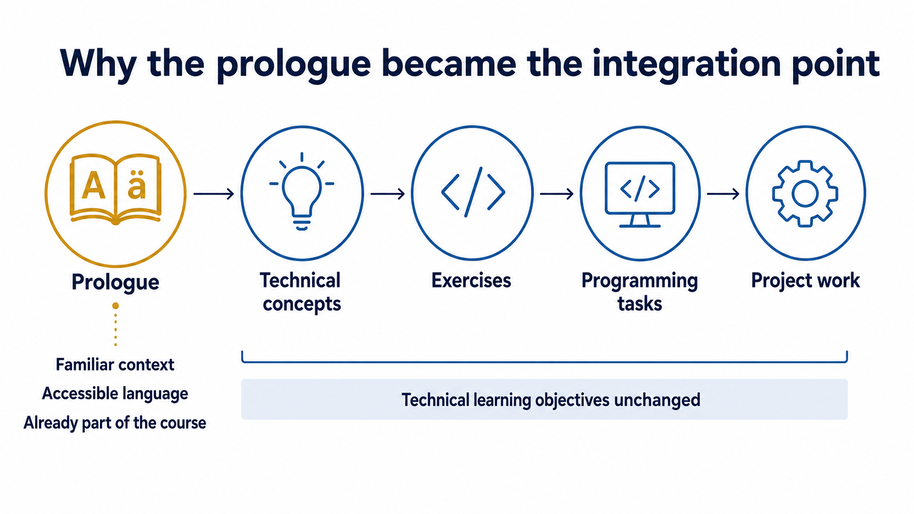
Core sections contain specialized terminology, code examples, and detailed implementation discussions, whereas the prologues use contextualized narratives and concrete examples. Adapting the prologues could therefore make Finnish-language engagement more approachable without changing the technical objectives, assignments, or assessment structure.
Choosing the prologues did more than identify a convenient translation target. It created a natural bridge between technical education and language learning. Finnish-language materials could foreground communication and comprehension within meaningful engineering contexts, while technical terminology could remain an important support rather than becoming the sole learning objective.
Implementing Finnish-Language Content in ELEC-C7222

Once the prologues had been selected, the implementation question became how to add Finnish without replacing or restructuring the existing English course. We adopted a layered model: the original technical material remained intact, and Finnish-language resources were added alongside it in the same learning environment. This preserved the course objectives, assessment structure, and learning progression.

The original English prologue remained the primary and default material. A separate Finnish tab allowed students to choose whether to engage with the additional content and to compare how the same concepts were expressed in the two languages. This arrangement supported students with different backgrounds and goals while ensuring that participation was not a condition for completing the technical course.
Figure 2 shows how the layers appeared in A+. An introductory explanation clarified the purpose and optional nature of the Finnish material, while the tabbed interface kept both language versions in one place. Students could move between them without leaving the course platform or interrupting the technical learning path.
Terminology Support and Reading Comprehension
Providing a Finnish version was only the first layer of support. Although the prologues were more accessible than the core technical sections, they still contained discipline-specific concepts and vocabulary that could interrupt comprehension for students with limited Finnish proficiency.
The Finnish texts were therefore enriched with just-in-time terminology support. Tooltips linked key technical concepts to English-Finnish terminology pairs, allowing students to inspect an unfamiliar term while reading. Each section also included bilingual glossaries in both English-Finnish and Finnish-English directions, so students could move between the two languages according to their needs.
Figure 3 illustrates both forms of support. The tooltips helped students resolve individual terms in context, while the glossaries made the central vocabulary available for review. Together, they reduced the risk that unfamiliar words would block students from following the overall argument of the text and aided the students' learning of technical vocabulary.
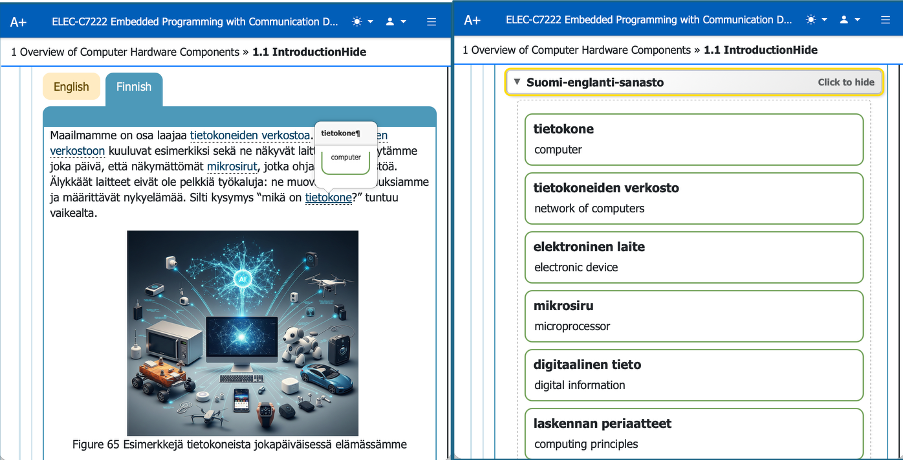
This distinction was central to the design: neither the tooltips nor the glossaries were intended as standalone vocabulary exercises. Their purpose was to support comprehension of authentic texts and help students connect terminology with the ideas and situations in which it is used.
Encouraging Active Engagement
Terminology support could make the Finnish text readable, but exposure alone did not ensure that students would actively process its meaning. Each Finnish-language section was therefore followed by content-related questions.

The questions focused on the main ideas and concepts rather than testing isolated vocabulary. Their purpose was to guide students toward reading for understanding and interpreting technical content in Finnish.
Figure 4 shows one of these questionnaires. To respond, students had to identify key concepts, interpret the text, and reflect on their understanding of the topic. In this way, the questions extended the terminology support into an active comprehension task.
Because engagement with the Finnish material remained voluntary, the course also needed an incentive that would not turn language learning into a requirement. Students could earn a small number of bonus points by completing the Finnish-language questionnaires. The English and Finnish versions presented the same underlying content, but only the Finnish sections included the optional questionnaires and bonus activities. Students who chose not to participate could still complete the course without disadvantage.
Collecting Feedback Within the Learning Environment

Evaluation was built into the implementation rather than postponed until the end of the course. Each Finnish-language section concluded with a short feedback questionnaire embedded directly in A+, allowing the project team to examine students' experiences with the integrated content.
Figure 5 shows the questionnaire that followed each section. Collecting feedback immediately after the activity reduced the distance between experience and response and complemented the broader perspective of an end-of-course survey. It also produced evidence across the course realization rather than at a single endpoint.
The questions addressed both participation and perceived learning. Students could report whether the Finnish version helped them learn vocabulary, understand the topic, become more familiar with Finnish in technical contexts, or gain a broader overview of the subject; they could also indicate that they had not used the Finnish content. The responses therefore captured not only perceived usefulness, but also the different ways students chose to engage.
Beyond ELEC-C7222
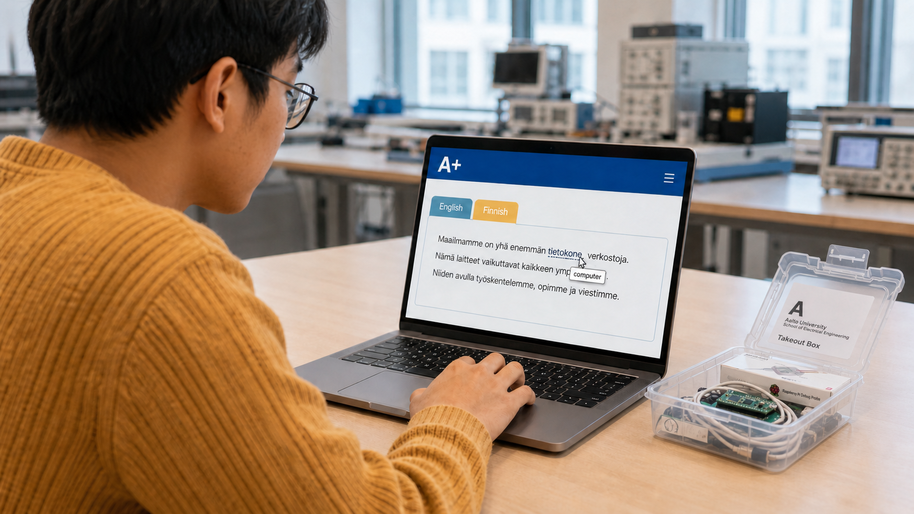
The layered model also made it possible to use the same content in two educational settings. ELEC-C7222 students could access Finnish-language material beside the English course content, while a Finnish language course participating in the project could use the same authentic engineering texts for language instruction.
This reuse was not simply an efficiency gain. It established a shared learning context in which disciplinary understanding, technical communication, and language development could reinforce one another. The implementation therefore enacted the project's broader aim of connecting technical and language education rather than treating them as separate activities.
A Transferable Implementation Process
For educators considering a similar integration, the implementation can be organized as a six-step process:
- Map the course structure and identify existing, context-rich material that can carry language learning without altering the core disciplinary objectives.
- Keep the disciplinary content accessible by layering the local-language version alongside the default material and making participation optional.
- Support comprehension with just-in-time terminology help and bilingual glossaries connected to authentic texts.
- Prompt active processing with questions focused on ideas and concepts; use modest incentives only when participation remains genuinely voluntary.
- Embed short feedback prompts near the activity to examine participation, perceived learning, and usability.
- Plan through co-design how the same resource can be used in both disciplinary and language courses.
The sequence is transferable, but its specific entry point, level of support, and incentive structure should be adapted to the discipline, the course workload, and students' language profiles.
Conclusions
The implementation shows that integrating language learning does not require redesigning a technical course around language. The value of the model came from the combination of its elements. The English content remained the default; terminology tooltips and bilingual glossaries supported comprehension; concept-focused questions encouraged active engagement; modest bonus points offered an incentive without disadvantaging non-participants; embedded feedback provided continuous evidence; and the same content could be used in Finnish language instruction. No single element would have met the design goals on its own.
Implementation, however, cannot by itself establish educational value. The next stage is to examine how students actually used these options: whether they opened the Finnish content, which supports they found useful, and whether they perceived gains in vocabulary, reading comprehension, understanding of the topic, or familiarity with Finnish technical communication. These questions connect the design intentions to evidence.
The next post examines the feedback collected during the course realization and discusses the key observations and lessons learned from the pilot implementation.
The illustrative images with caption (*) were generated by Codex using OpenAI image generation.

Show other posts from this blog

Integrating Finnish into Aalto’s English-language Technology Degree: From Pilots To a Scalable Model
Technology Sector Finnish connects study planning, field-specific courses, and technical-course pilots to support international students’ employability.