Connecting Technical Education and Finnish Language Learning: Design Challenges
by Yusein Ali, University Lecturer at the Department of Information and Communications Engineering Elisa Räsänen, University Lecturer at the Language Centre
The first post in this series introduces the motivation for the Technology Sector Finnish project and its broader model for supporting Finnish across technical courses, field-specific language instruction, and study planning. This post focuses on one part of that model: the design of Finnish-language integration in ELEC-C7222 Embedded Programming with Communication Devices.

As part of this project, a multidisciplinary team of two technical educators and two language educators selected ELEC-C7222 Embedded Programming with Communication Devices, a third-year course covering embedded systems, C++, real-time operating systems, and Bluetooth Low Energy, as the pilot environment.
The team's aim was twofold: to offer Finnish-language support within the technical course and to develop shared materials that could also be used in Finnish-language instruction. At first glance, a highly technical engineering course may seem an unlikely setting for language learning. This post examines how the team defined the integration and the design challenges that followed.
Defining the Learning Goals
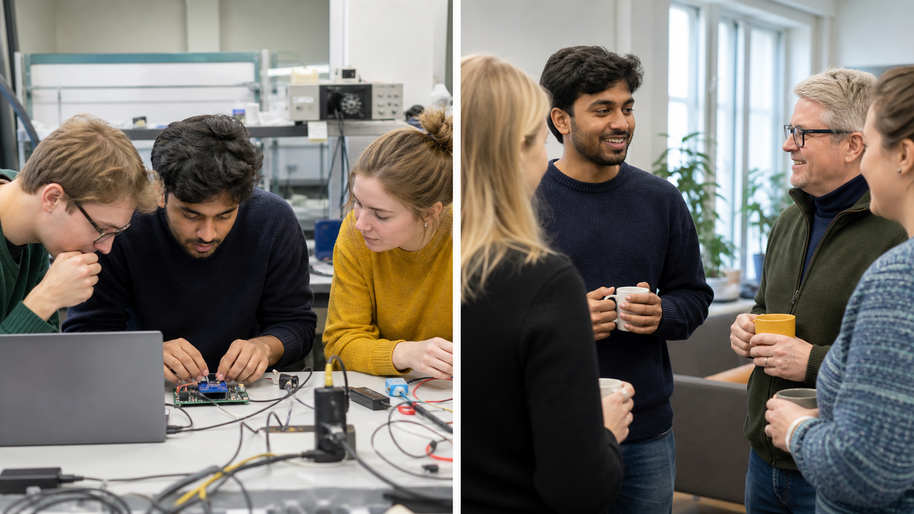
Before designing any materials, the multidisciplinary team of two technology and two Finnish language instructors needed a shared understanding of what students should ultimately be able to do in Finnish. Technical and language educators brought different disciplinary perspectives, so agreeing on the intended competencies became the first design task. The goal was not simply to teach technical terminology, but to support students' participation in Finnish society and professional life more broadly.
After several weeks of discussion, the team identified the following broader competencies for students to develop across their studies and into working life:
- have an informal conversation in Finnish at the workplace
- describe and pitch their work in Finnish
- follow daily events in Finland
- understand texts related to entrepreneurship and business management
- apply for jobs in Finnish
- form connections within their professional network
- work on projects in teams (partially in Finnish)
- utilize strategies to continue learning Finnish throughout their Master’s studies and working life
Together, these outcomes emphasized functional participation across social and professional settings rather than the ability to perform technical work entirely in Finnish. Technical terminology remained relevant, but terminology alone could not support the communication and comprehension skills the team wanted to develop. The course therefore needed content that placed technical concepts within workplace, career, and societal contexts. This distinction later guided the use of bilingual terminology support and glossaries as aids to understanding discipline-specific texts, not as standalone vocabulary exercises. The outcomes also highlighted strategies for continuing to learn Finnish independently.
Connecting Technical and Language Education
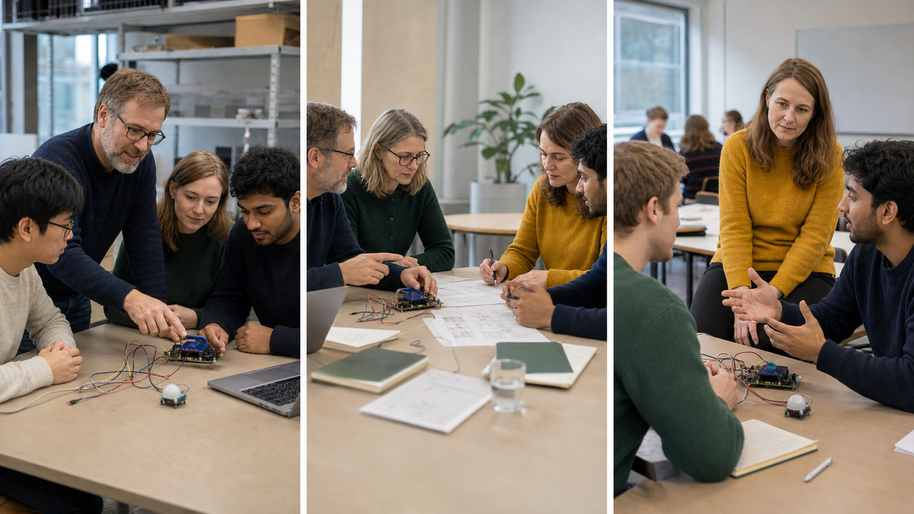
Technical and language courses often operate separately: one emphasizes disciplinary knowledge and professional competencies, while the other emphasizes communication and linguistic development. Yet activities such as describing one's work, discussing technical concepts, participating in project meetings, and building professional networks require both.
The project therefore treated the problem as forming a bridge between the two domains. Integrated learning materials would let technical students encounter Finnish through authentic engineering topics, while giving Finnish-language students access to discipline-specific content. The same materials had to remain technically meaningful and pedagogically accessible.
This required sustained co-design. Technical educators contributed domain expertise, authentic contexts, and existing course materials; language educators contributed language pedagogy, learner support, and methods for adapting content to different levels of Finnish proficiency.
Design Challenges
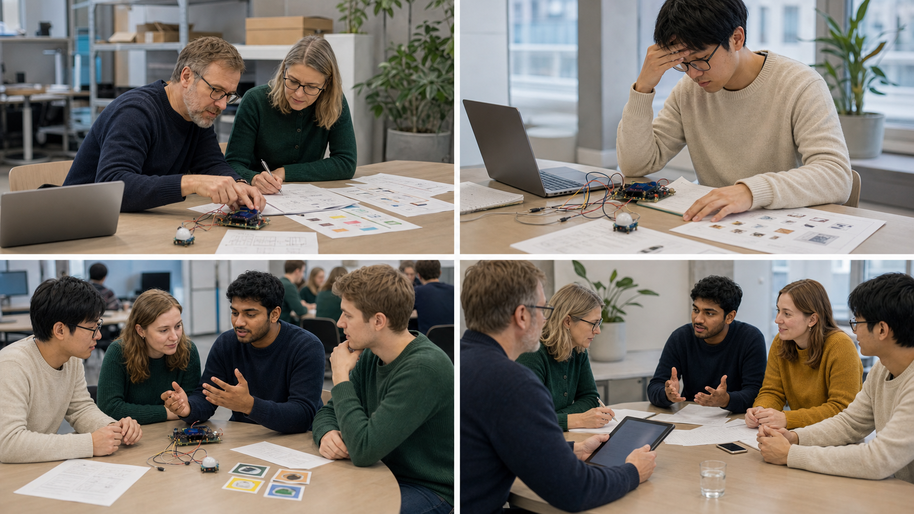
Translating the shared outcomes into a technical course introduced four connected design challenges.
The first challenge was adaptation and recontextualization of existing course content. The goal was neither to translate technical material directly from English into Finnish nor to reduce the course to vocabulary practice. The integrated learning materials had to make technical and professional topics meaningful and accessible to students whose Finnish was still developing.
The second challenge was cognitive workload. Students take a technical course primarily to learn the subject matter and may not be ready to switch into a language-learning mode. Finnish-language activities therefore needed to support learning without disrupting the technical flow or adding excessive workload.
The third challenge was inclusiveness. The integrated learning materials needed to benefit students across linguistic backgrounds and proficiency levels, including native Finnish speakers. For more proficient students, they could prompt reflection on terminology, English-Finnish differences in expressing engineering concepts, and multilingual professional communication.
The fourth challenge was evaluation. The team needed evidence of how students perceived the materials, how useful they found them, how much additional workload they created, and whether they supported the intended language outcomes. This called for deliberate assessment and feedback mechanisms.
These challenges could not be solved independently: reducing workload could weaken language-learning opportunities, while tailoring activities too narrowly could reduce inclusiveness. The design therefore had to balance the requirements as a system.
Taken together, the challenges produced a set of integration criteria that balanced authenticity, accessibility, workload, inclusiveness, and evaluation. The next question was how these criteria could guide course design beyond this specific pilot.
Applying the Design Principles in Other Courses
Although the pilot focused on a specific course, its design process offers a transferable approach for other disciplines. The process can be organized around four practical decisions:
- Identify authentic communication situations that connect language use with the discipline.
- Select existing course materials that can be adapted without changing the core disciplinary objectives.
- Provide voluntary, low-threshold opportunities for engagement that do not add excessive workload.
- Plan how usefulness, workload, and learning will be evaluated across proficiency levels.
These decisions are best made collaboratively by disciplinary and language educators.
Conclusions
Integrating Finnish language learning into a highly technical engineering course initially appeared to be a language-related task. The design process showed, however, that the central challenge was educational: how to create meaningful opportunities for language use without weakening the technical learning objectives, adding excessive workload, or excluding students with different linguistic backgrounds. This reframing shifted the project away from treating translation or terminology as standalone goals and toward designing authentic situations in which disciplinary knowledge, terminology support, and communication skills could reinforce one another.
The outcome of the design phase was therefore not a finished collection of activities, but a set of principles for implementation. Effective integration depends on close collaboration between disciplinary and language educators, careful adaptation of existing materials, low-threshold participation, and evaluation of both usefulness and workload. These principles shaped the implementation in ELEC-C7222 and the use of the resulting materials in both technical and Finnish-language instruction. The next post describes that implementation in practice.
All images were generated by Codex using OpenAI image generation; concept and direction by the author.

Show other posts from this blog

Integrating Finnish into Aalto’s English-language Technology Degree: From Pilots To a Scalable Model
Technology Sector Finnish connects study planning, field-specific courses, and technical-course pilots to support international students’ employability.